
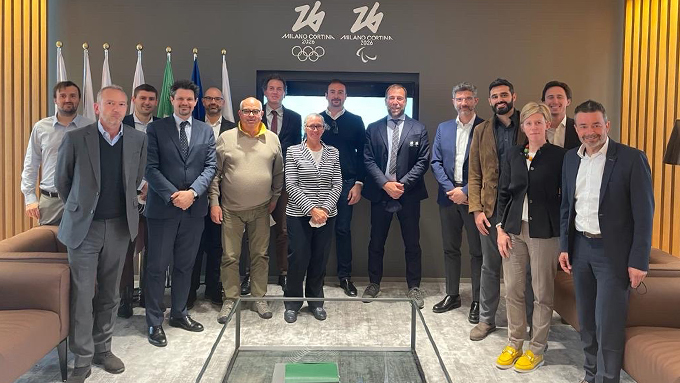
Head of Transport for Milano Cortina 2026 and Director of Citec Italy, Stefano Manelli looks back on the preparation of mobility for the 2026 Winter Olympic and Paralympic Games. Between infrastructural and operational challenges, transport planning is the invisible engine behind the success of a global event, while also being a central element of its territorial legacy.
Planning imperatives and change management
The project originated in 2018, the year of Italy’s candidacy. From that stage onward, the main challenge was to design a transport system unprecedented for the country, with service levels well above existing standards. Beyond strengthening infrastructure, the goal was to redefine the accessibility of remote and geographically complex territories.This ambition required a long “change management” process, involving both exchanges with the International Olympic Committee and a profound internal transformation of the organizing committee. Moving from the candidacy vision to operational reality demanded several years of advance planning to manage the complexity of athlete, staff, media, and spectator flows.
Territorial integration and stakeholder coordination
The project had to reconcile heterogeneous territories : the Milan metropolitan area and the Alpine zones, spread across several regions and autonomous provinces. This configuration required an unprecedented level of governance. The organizing committee acted as a technical and institutional conductor, fostering continuous dialogue with local administrations, regulatory authorities, and transport operators. The success of the model rests on turning territorial fragmentation into an integrated multimodal system, built on cooperation and the valorization of local specificities rather than a top-down logic.
Sustainability as a design principle
Sustainability was treated as a design principle rather than a constraint. Stefano Manelli speaks of « sustainability by design », an approach in which environmental considerations are built into transport systems from the outset.In practice, this translates into prioritizing rail for intercity connections and developing low-emission shared mobility solutions for the last mile. The Games are thus conceived as a living laboratory, capable of encouraging lasting changes in mobility behavior. The temporary measures put in place, while sometimes restrictive, serve as a testing ground, and their value will depend on their ability to be turned into permanent policies and infrastructure.
Operational excellence of services
On the operational side, Stefano Manelli shares the difficulty of setting up, in a very short time, a transport system equivalent to that of a major metropolis, with no break-in period.In this context, Busitalia played a decisive role, mobilizing more than 600 buses with a delay rate below 0.5%, demonstrating remarkable operational reliability. In the Alpine areas, operators such as STA, Trentino Trasporti, Dolomitibus, and the FNM group integrated Olympic services into existing local networks, creating a multimodal system that strengthens accessibility to the valleys and could become a model for sustainable mountain tourism mobility.
The Milan model and ATM’s legacy
Particular attention was paid to urban mobility in Milan. Reinforcements to metro and surface lines, along with extended operating hours, made it possible to handle around 80,000 additional passengers during the competition period. The most striking result concerns modal shift: more than 70% of participants and spectators used public transport, compared with a usual urban average below 30%.This shift reflects a significant behavioral change, supported by effective policies to expand service capacity. The City of Milan and ATM are now studying how to make some of these measures permanent, turning the Olympic experience into a structural legacy for urban mobility.
Complexity and the legacy of major events
The Olympic Games remain inherently complex systems, capable of temporarily but profoundly transforming the use of a territory. No territory can be fully prepared for them without advanced planning and sophisticated modeling tools. In this context, the role of specialized consultants like Citec is essential for building scenarios, simulations, and operational models that support public decision-making within the strict constraints of the « Olympic product » ,while ensuring the continuity of local life. Transport’s share of the overall budget confirms its strategic importance.Mobility is the first and last point of contact with the Games: the true calling card of a country’s organizational capacity, and one of the most tangible legacies left to host territories.
On the same topic
-

Transportation Technical Assistance for Special Olympics
8 October 2026Read moreCitec collaborated with Special Olympics (SOI) on the development of transportation planning resources and operational guidance for future Special Olympics events.
-
Citec supports mobility for the Super Cup final
13 August 2026Read moreOn August 12, Salzburg hosted the 2026 UEFA Super Cup final, a major European football showdown won by Paris Saint-Germain against Aston Villa. Citec supported the Local Organizing Committee (LOC) and UEFA teams on the mobility plan.
-
Next Mobility Exhibition: a look back at Stefano Manelli’s participation
22 May 2026Read moreMobility as the first and last memory of the Games: Stefano Manelli’s vision at the « Innovability » conference of the Next Mobility Exhibition in Milan.